



I came across a video post recently where a woman asked this question:
Is the world really the dumpster fire that the media says it is, or has it always been like this?
That is a great question.
If, for no other reason than our mental health, it’s good to step back and take a crack at answering it.
Let’s start with George Seurat.
His most famous painting, thanks in large part to Stephen Sondheim, is “A Sunday Afternoon on the Island of La Grande Jette.” It is not called “Sunday in the Park with George,” but it is in the public domain now so, I guess, we can call it anything we like.
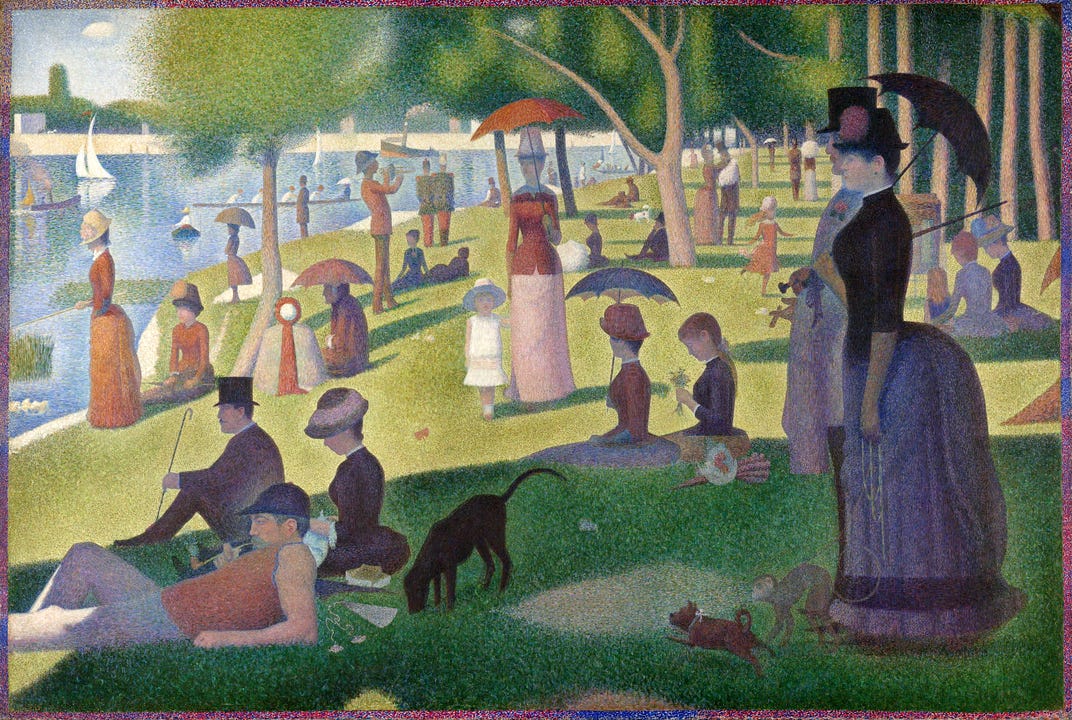
I have never seen the original of this; it hangs in the Art Institute of Chicago and it is huge. Almost eight feet by ten feet.
But I have, however, seen “The Circus,” which is just about the same size.
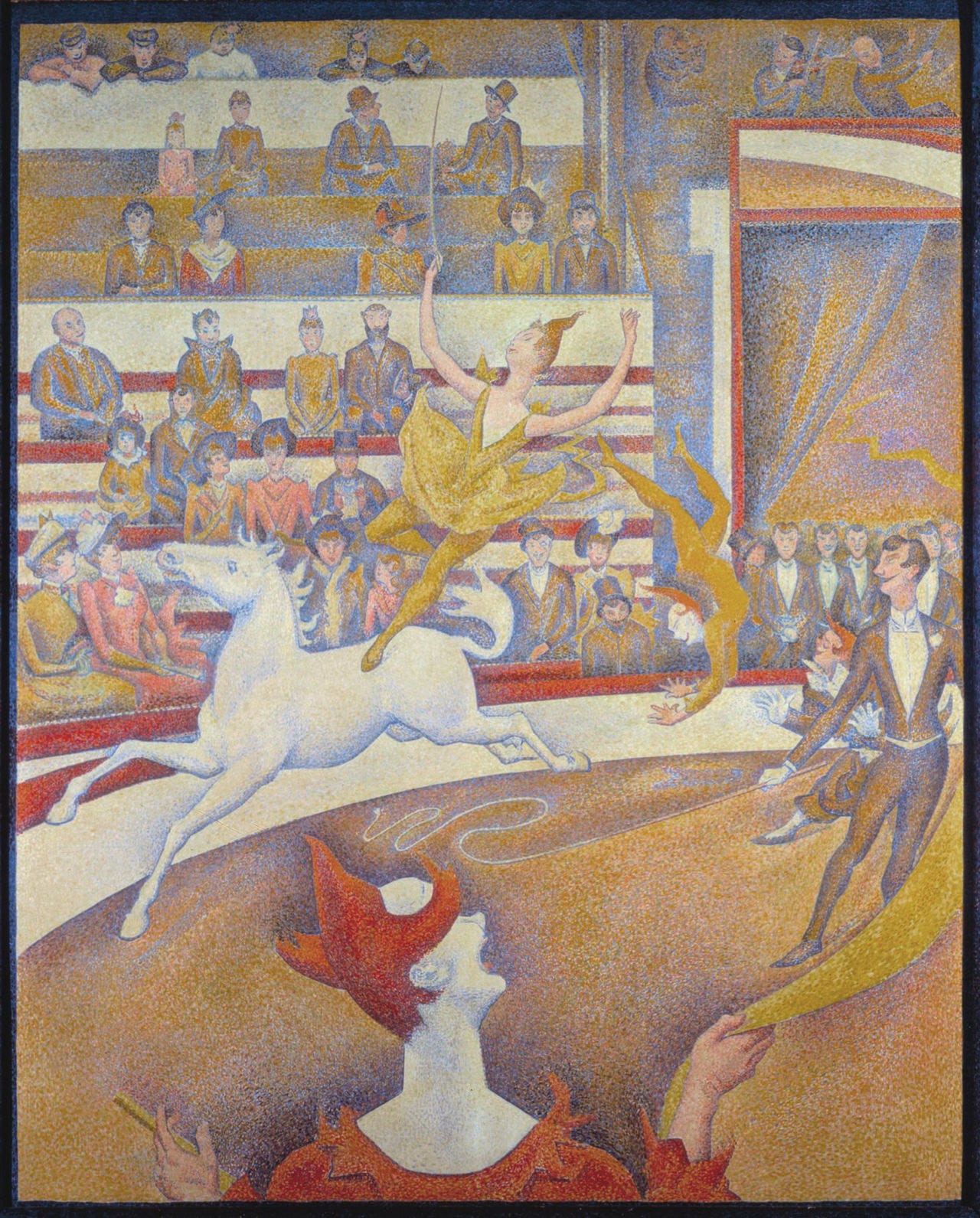
Seurat (who, I was horrified to find out, died when he was thirty-one years old), was one of the first “pointillist” painters, a late-nineteenth century style that was relatively short-lived.
Maybe it was short-lived because of the time it took to complete a painting, applying one dot (point) at a time. (I am not making this up.) That was the practice in pointillism: to apply dots of pure color in such patterns that, when you step back, make a cohesive, optical whole.
Here’s what the violin player, in the corner, looks like when you get up close:
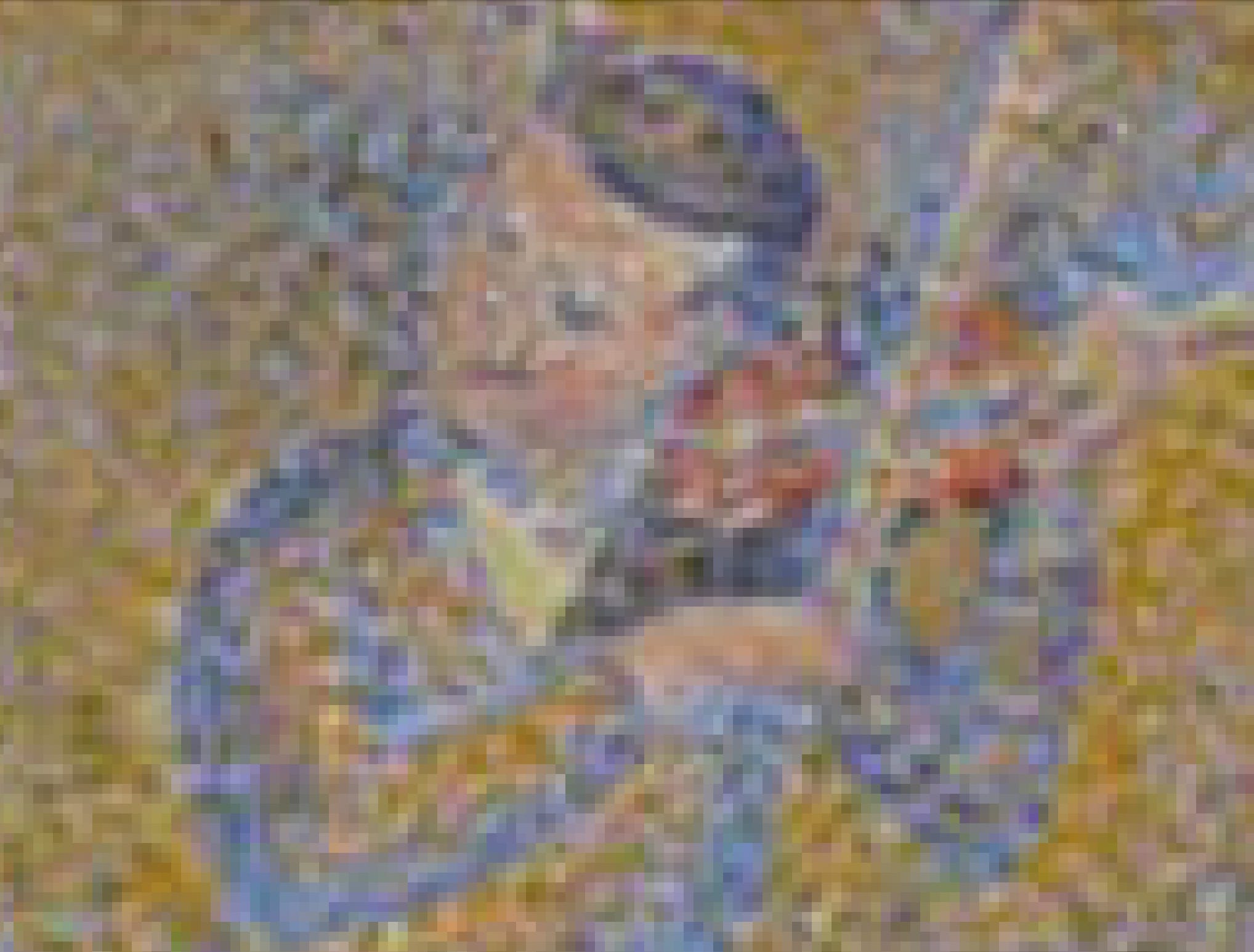
So, if you’re standing very close to the picture, it’s very hard to tell what you’re seeing.
The way we get information today is exactly like the little points of pointillism. We get tiny, little digital (mostly) bytes, without context. They may be a neutral color. But that’s unlikely. More likely: a little red for rage, a little yellow for a smiley face, a little green for envy, some magenta for excitement, maybe soft blue for calm and peace.
And we try to figure out what we are seeing. What???
This is the business model for news media: keep you as close to the picture as possible. They want your eyes and ears, not your brain—unless something through your eyes and ears alerts your limbic system and causes a flash of emotion.
I think it’s safe to say, we all have paint on our noses.
Stepping back.
There is no wisdom automatically conferred with age.
There is only one thing you might get: perspective. And even that’s not guaranteed. Whether perspective enhances your outlook or only confirms built-in biases and assumptions is also up for grabs.
To compound matters, should you get a glimmer of wisdom, the first inkling will be something like this:
You don’t really know anything.
Sages throughout the ages (I’m keeping that in there because it would make a great name for a band) have landed at this same conclusion. A short list: Socrates, Einstein, Carl Sagan, Isaac Newton, Montaigne, Confucius. All of them said the beginning of wisdom is realizing that you know nothing.
Undoubtedly many women came to exactly this same conclusion. But they realized the men around them would be unable to understand, so why bother telling them?
Now, I am aware that our dumpster fire is still burning. But before we bring out the hoses, a few more thoughts.

Knowing nothing applies to the BIG questions.
The existential questions. It doesn’t mean that you wake up one day and don’t know how to make the coffee. Or how your shoes go on. We don’t forget the things we know by habit, at least if we’re lucky. Nor do we un-learn things that are empirically verifiable.
As the son of a Fire Chief, I do know a little about fire. I spent many nights sleeping at the firehouse, as a teen, and went on many calls. I have seen actual dumpster fires. I know how the crackle of the words “flames showing” over the radio in the engine truck concentrates the mind. And, perhaps the most surprising, almost mythological thing about fire: how mesmerizing it can be and how fast it can move, given the proper conditions.
Also at my disposal, answering this question, I have a little bit of history.
1968 was a dumpster fire of a year. If you go through the year, month by month, it is just one thing after another: starting with the Tet Offensive in January and ending with me breaking up with my freshman-year girlfriend in December. In between, there were assassinations, demonstrations, riots and the Beatles’ White Album. (See: How bad was 1968?)
For some time, it did seem the world was on fire.
But for fire to spread, it needs combustible material round it. A Christmas tree on fire in a desert is no danger to anyone. Put it in an old-growth forest, in the middle of summer, after a season with no rain and it becomes lethal.
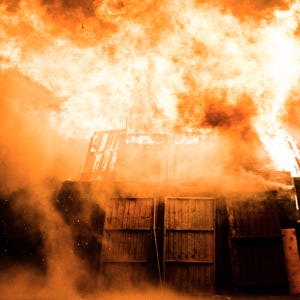
In 1968, there was enough institutional power, enough water pressure, to put that dumpster fire out. It was contained. The lure of the American Dream (still true, then) and upward mobility (still true, then) created fire-proof insulation around institutions.
Why complain when you can make money?
As Donald Fagen once said:
All those day-glow freaks who used to paint their face
They’ve joined the human race
That is not the case now.
Stepping back, returning to he Seurat metaphor, I can see a lot of kindling on the ground. The broken barriers of previously agree-upon norms, the inclusion of religion into the arguments we are having (this has huge implications), the wealth divide (which means people have less to lose), and the drop in institutional water pressure i.e. influence.
So yes, there have always been dumpster fires. The question is: which ones burn themselves out, and which ones spread.
I guess we will find out. Perhaps sooner than we think.

Bill Evans, the jazz piano player, has always been one of my heroes.
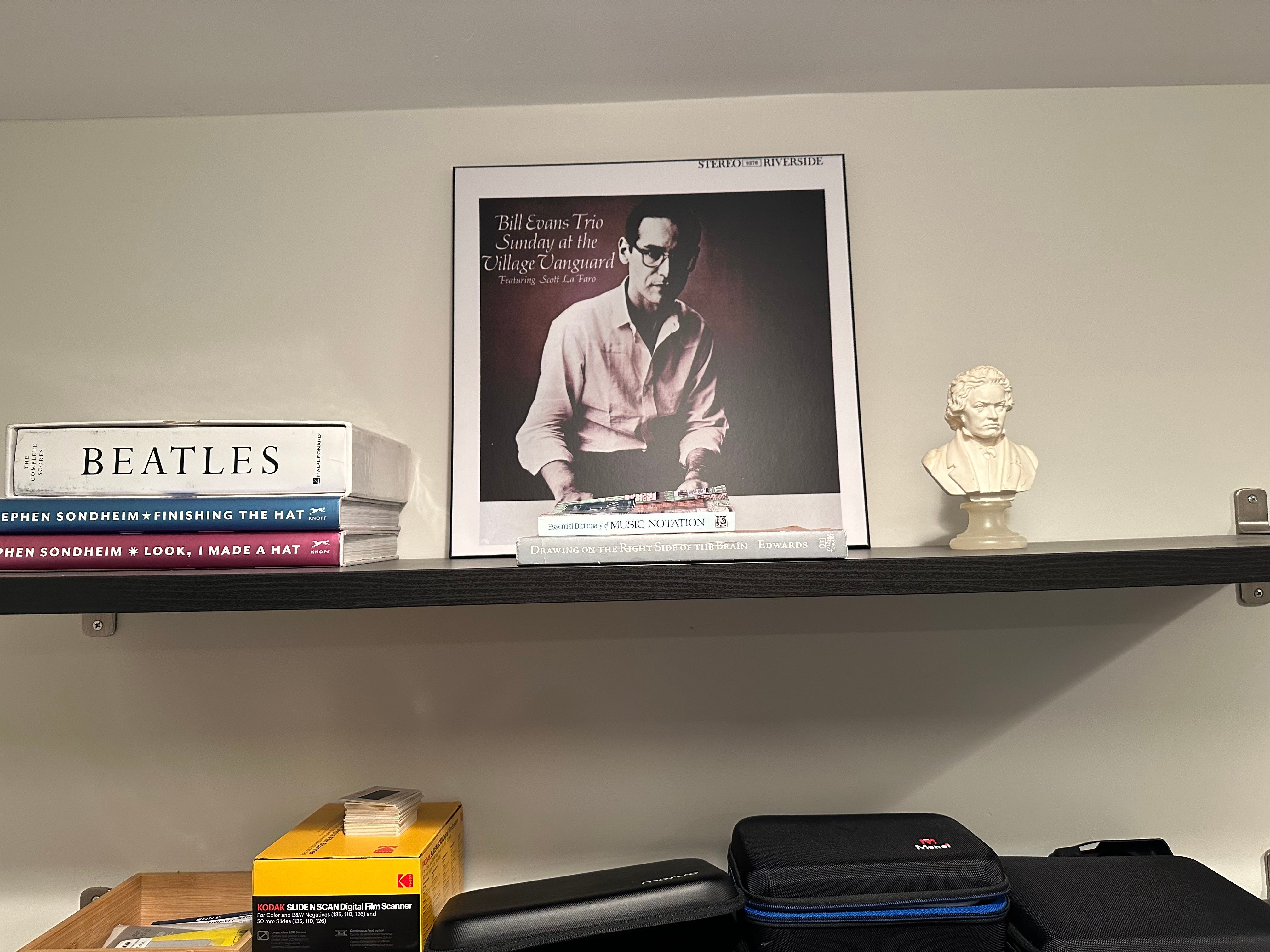
His composition “Peace Piece” was recorded as an improvisation after a recording session had ended. One take, I imagine.
It was obviously in my subconscious mind when the following piece came into being. Although, I’m afraid to say, simple as it is, it took three takes:
If you “like” (heart) this post or—even better—comment, it is a big help. The post gains more visibility.
Thank you for reading! Apologies in advance for typos. (I am a dyslexic proofreader!)
And if you enjoyed this piece, please consider sharing it with a friend:
What a great read John. And beautiful piece of piano. So peaceful.
I loved the analogy between the pointillism and the news. So on point. (Pun intended)
Great insights John