

My Dreamhouse
Or: what goes on while I'm asleep.

I. Such stuff as dreams.
I can’t remember the last time I had the “final exam” dream. You know the one: you show up to the class in your pajamas, carrying your cup of coffee and a slide rule, ready to take the Calculus 101 final but it’s really the Sociology 357 final exam and you haven’t read any of the books or even been to one class and you are totally, royally screwed.
It is a classic anxiety dream. At its center are the single-most powerful fears we frail human beings have: the fear of being judged, evaluated, called out, exposed as the frauds we most certainly think we are.
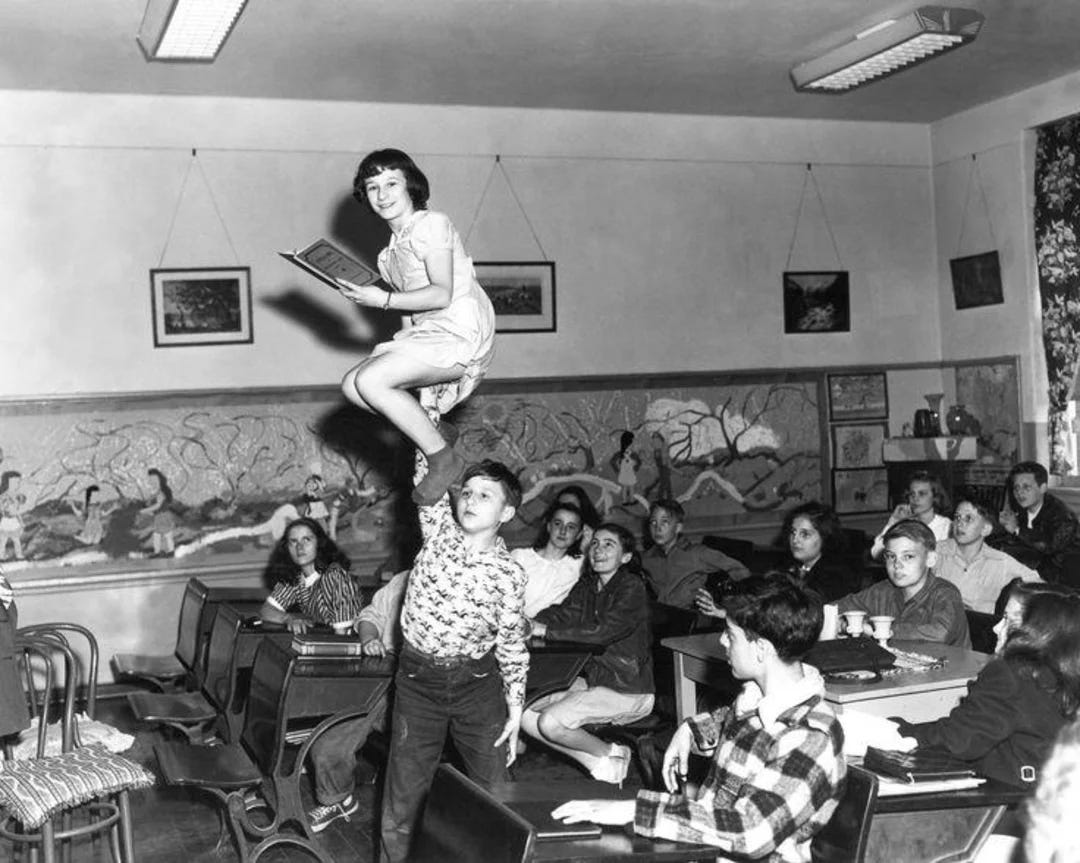
Now, while I don’t have that dream anymore, I have another one.
The setting is always the same. A three-bedroom cape, 1,300 square feet in a modest, working-class neighborhood where no one ever locked the doors. I lived there from the time I was eight until I was eighteen — my most formative years, the place where my original OS was developed. Here’s what’s strange: we lived for twenty-five years in another house where we raised our family. I loved that house and still miss it. But it never shows up in my dreams. (We have lived in other places longer than I lived in that small Cape and they never make an appearance either.)
The subconscious, apparently, chooses its own real estate.
II. Every night (I think)
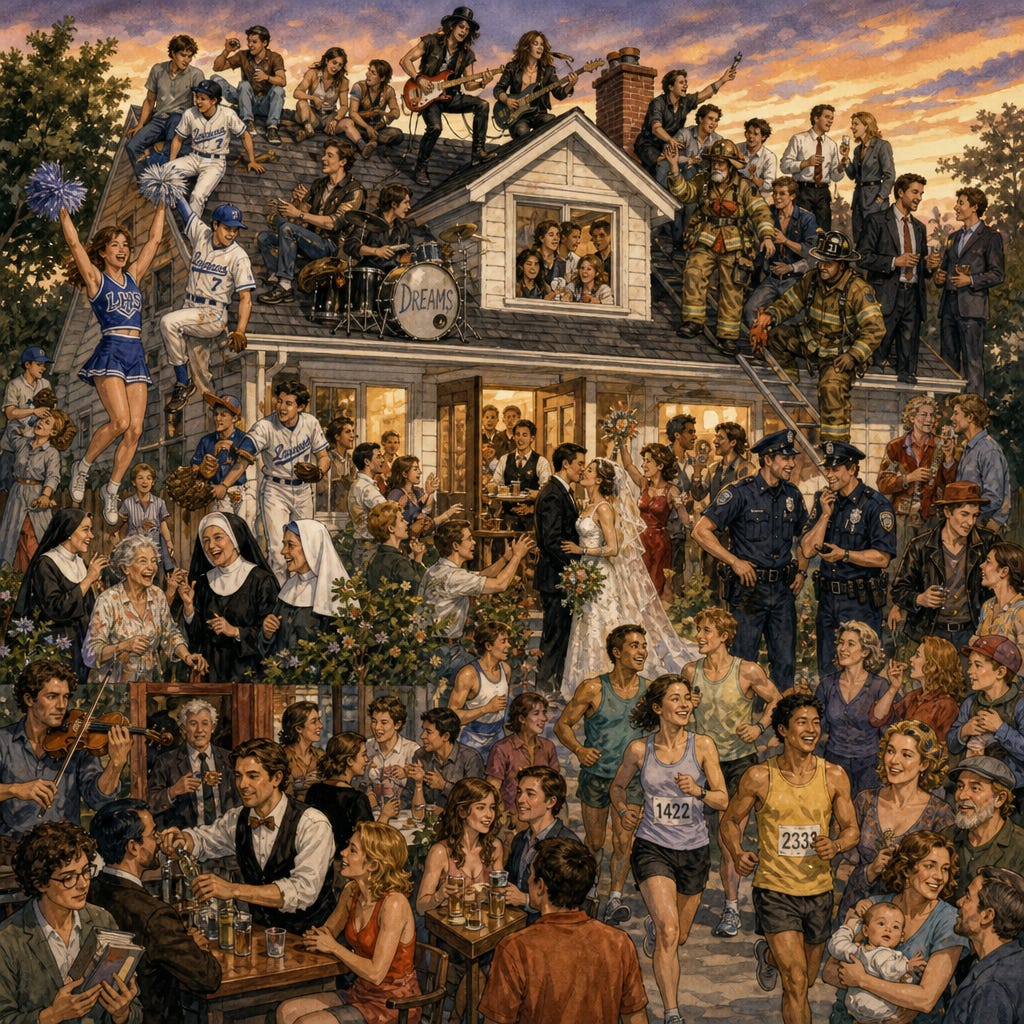
Into this small house, an ever-expanding cast of characters gathers nightly. It’s part Broadway production, part enormous cocktail party, part Sunday service, and nobody—especially me—seems entirely clear on what is going on. Songs break out from different parts of the house: “Oh What a Beautiful Morning” competes with “Take Me Or Leave Me” from Rent in the living room (which has somehow expanded to the size of Symphony Hall.) There’s a wedding in the kitchen and a birthday party in the back yard. My high school band, The Oatmeal Bedspread, is playing “Hold On, I’m Comin’” in the pizza-parlor-panelled basement while my Uncle John sings “Mother Machree” out on the porch.
It is Bedlam.
There is also, notably, no audience for this production.
III. And the cast
Oh yes, the cast. Ed — former congregant, novelist, a man who has thought harder about the human condition than most — is deep in conversation with Doug, a bartender from the 70s Rusty Scupper, a man who has seen the human condition from the other side of the bar. They are separated, in my timeline, by thirty years and every conceivable circumstance. In this room they appear to have a great deal to say to each other.
My sister Eileen and my mother-in-law Kay are talking a blue streak. In real life, they never met. The only thing they have in common is Florida. I, meanwhile, appear to have become irrelevant.
And in the corner — I have to look twice — my father is talking with Mark, a seminary professor from whom I learned more than I will ever be able to use. They never met. They couldn’t have. And yet they are deep in something, my father leaning in the way he did when a conversation had his full attention, and I find I don’t want to interrupt.
The dead mingle with the living as if the distinction never mattered much. Immigrant-Irish relatives—barely remembered, just off the boat, carrying whatever they carried across the Atlantic—are having a perfectly good time with the Yuppies I worked with in 1987. Seminary friends are deep in conversation with bartenders from the 70s-80s Allston-Brighton club circuit. Childhood friends who never knew my adult life are entirely comfortable with people who only know me out here in the Berkshires.
Nobody is performing for anyone.

IV. Read the room
For all the lives I have lived in this one life, there is one skill that has been the through-line. I have always known how to read a room. As a child it was survival—you learn early which way the moods are blowing, or there’s trouble. As a musician, reading a room was the difference between a good night and a long, lonely ride home. In advertising it was the whole job: if you could read the room at a presentation, you were golden. And in ministry it was the one thing they never taught in seminary but the one thing you needed when you walked into a sanctuary.
These rooms, I cannot read.
But honestly, it doesn’t really bother me.
By every measure of the anxiety dream, this should be a nightmare. The chaos is total. The cast is enormous and ungovernable. The production changes without notice. I have no script, no cues, no sense of what is being asked of me or whether I am delivering it.
And yet I don’t wake up in a cold sweat. I wake up, when I remember the dream at all, with something closer to wonder. Maybe even something like longing.
Which means this isn’t an anxiety dream wearing a party hat.
It’s something else entirely.
Consider what is actually happening in this room.
V. What I think is really going on
Nobody is performing for anyone. In every room I have ever read, someone was performing. That’s what rooms are — stages with an audience that has opinions. But not this one. In this room, everyone has apparently already passed the exam. The verdict is in, and it was fine, and now they are just here. Together. In a three-bedroom cape on a 5,000 square foot lot that somehow contains all of them.
I have spent considerable energy in my life trying to locate through-lines — in a song, in a campaign, in a sermon. The through-line in this room, the one I couldn’t see at first, is simply this: everyone here was known. By me, yes. But more than that—they were known, period. Seen. The Immigrant-Irish relative who never got a biography. The waitress who never made the obituary page. The childhood friend the world forgot about ten minutes after high school ended.
They are all, in this small house, equally present.
No hierarchy. No pecking order. No one more important than anyone else.
The casting director, whoever that is, got that part exactly right.
Now the official version of heaven doesn’t really work for me.
Not the clouds, not the wings, not the reunion-special sentimentality of it. I spent too many years in too many hospital rooms with the dying and the dead. I don’t see the world celestially. I see it as human and mortal.
And yet.
Every night — or most nights, or at least the nights I remember — my subconscious has been quietly building something. Without my permission. Without my theology. Without asking whether I find the whole enterprise intellectually defensible.
It has been building a place where everyone I ever knew shows up in the same small house. Where the dead and the living have apparently worked out their differences. Where nobody is auditioning, nobody is judging, and nobody — including me — knows exactly what the production is, but everyone seems fine with that. Better than fine.
“Every burden is lifted.” (Isaiah 10:27) Not because the problems were solved. Because the exam is over.
It turns out, we never had to prove anything. We only had to show up.
Maybe the subconscious knows something the waking mind just can’t seem to grasp. And maybe what I have trouble believing, I have already been visiting.
Don’t believe me?
Then I’ll see you in my dreams.

A few words about this, beginning with: yes, I did secure copyright permission to use this song.
Just prior to the pandemic, I had the idea to recreate “Rubber Soul” playing all the instruments and doing all the vocals. Why? I’m not entirely sure.
I think it may have been simply to inhabit the songs, to live inside them for a time.
I read and watched as much as I could about the recording techniques, the guitars that were used, the amps that were used, and even how George Martin recorded the little baroque piece that became the instrumental part of “In My Life.” (Since the part is mildly complex, he slowed the tape down to 50% and then played it at half tempo. Good enough for George, good enough for me. I did the same thing.)
As I was finishing writing this week’s piece, I realized this was the perfect musical accompaniment. I chose these pictures totally randomly.
As happens in my dreams.
No paywall—ever. If this piece speaks to you, share it.